Many beggars partake in some kind of busking or street art in order to entice people into giving them money, and they are not called scammers. Just today I saw a homeless woman in the centre of Oxford drawing a kite on the pavement with chalk. She is not a scammer for doing this.
Over the past couple of days I have been reminded of a phenomenon which was once very familiar to me: men on the street making sculptures of dogs made out of sand. This was a common sight on Buchanan and Sauchiehall Streets when I used to live in Glasgow.
Recently I started to see videos online about these sand dogs which fall into 2 camps:1
- people appreciating the dogs at face value
- sand dog truthers
By which I mean people who are certain that the sculptures are fake. They present this argument in anonymous comments and videos accosting the street performers2 but only provide hearsay to back up their claims. I have appointed myself the task of determining whether or not it is true that these sand artists are the real deal or scammers.
First of all: what do people mean when they say that these men are "scammers"? I posit that they mean that the people who make these dogs did not put any effort into their craft and are essentially begging and using the impressiveness of a skill they do not actually possess to solicit donations.
It is not, in any case, a very good scam, in that it doesn't really "dupe" you: if you're unimpressed by the artwork — which the people calling it a scam presumably are — you simply don't contribute.
The larger issue that I see though is that based on a slightly sceptical and over curious reading of the evidence commonly presented to me online3 there is no actual evidence that this is a scam.
Many people in the comments of these videos claim that dog sculptures are made using moulds. This is not a new idea.4 There are 2 ways I've seen suggested that this might work:
- the mould forms some internal structure which they just place some extra sand on top of to create the illusion of a sand sculpture
- they fill a mould with sand and lift it off to form the shape of the sculpture
The first option can be tested on the spot, and destructively, by shoving something into the sculpture to see if it collapses (or otherwise behaves sand like). The second is harder, because once the shape has been formed the mould can be spirited away and hidden. To settle that one you have to watch the thing being built.
I have found no affirmative evidence of these sculptures being set up using a mould. The closest anyone gets is anonymous testimony in the comments of Waywell's post.5 Given this we will assess the issue based on the evidence we do have.
The first option goes quickly. I have seen at least one video of a person accosting one of these guys saying it's a scam and deliberately pressing his finger into the sculpture. The sand moved as you would expect for a real sand sculpture.6 Juliet Robertson has done the same test more politely, on two different dogs in two cities, and written it up.7
The second takes longer, but videos exist showing the sculptures in various states of construction. In one several dog heads are finished while the bodies behind them are still amorphous blobs of sand. Better still, Robertson also has a photograph of an Edinburgh pitch in which the dog is not yet a dog at all: just a heap of sand tipped onto a cloth, next to the bags it came out of.8 It makes sense that the head would be built first as it is the cute part and presumably the money maker, and if there was a mould it would presumably make the entire sculpture at once rather than head first. Demonstrations of how to build these dogs are readily available online.9
The fact that they are often similar and always dogs does lend credence to the idea that they are a mould due to the repetition. However, I think this can easily be explained by the fact that dogs will perform well due to their cuteness, and once an artist has a technique for creating a sculpture that performs well they are likely to repeat it. Not to mention the way dogs lie is conducive to a structure made from sand. Furthermore no two of the sculptures I have seen are exactly the same10 and if a single mould were being used you would expect them to be (or to be drawn from a smallish pool).
The reason I think this is interesting enough to write a blog post about is the irony. The sand artist is only supposedly dishonest, and there is at least some evidence that he isn't. The commenter accusing him, asserting something he has no evidence for, actually is dishonest (if only intellectually).
Clearly the sculptures are real: when poked they move like compacted wet sand — not something solid; they have been spotted and documented under construction; no "sand dog truther" has ever provided any evidence of a mould being used other than hearsay. It's not that unbelievable that a man can make a sculpture of a dog from sand given a little practice.
What can we learn from this? I think "sand dog sculptures are fake" might be the world's lowest stakes conspiracy theory. It has no large scale impact on the world but it has the same shape as the real ones: a claim adopted without evidence because it fits a story you already believe. It is too easy for a claim to go unsuspected simply because it feels right.
People have a right to be sceptical and I think that is healthy. Just as I have a right to be sceptical of the scepticism. Although I have now spent an evening gathering citations about pavement dogs in order to be the man who saw through the men who saw through it. Make of that what you will.
Both of these are truthers: @superdave_303 and @stevenglasgow94.
@barebones404 is an example of the latter. For the former, see the comments quoted below.5
I'm going to generalise my experience here and assume that the types of videos I see about these dogs are roughly representative of the videos of these dogs.
The earliest clear statement of it I can find is David Waywell's 2014 post So is this a scam?, which rests entirely on the repetition argument — always a dog, always lying down, same jowls, same four holes.
One commenter: "its a fiberglass mould coverd in sand... saw him setting up in BOLTON". Another says a chipped sculpture in Cardiff showed "a blue plastic underneath". No photograph, no video, no name attached to either.
@trudyapparel1. @povaberdeen shows a street sculpture part-way through construction as well. Best of all is Robertson's photograph of an Edinburgh pitch, in which the dog is still a heap of sand on a cloth next to the bags it came out of.
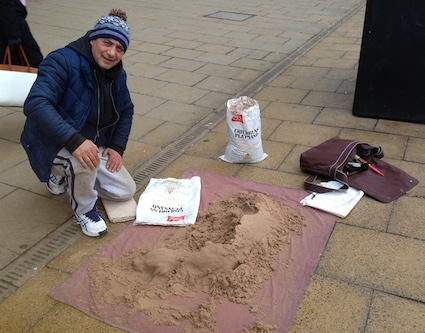
@jpsandmanca builds one from nothing, start to finish — though as a deliberate demonstration off the street rather than at a working pitch.
Most clearly @scotlandbyprestige, but note that no two dogs in the street videos linked in this post are the same one, and they were shot by unconnected accounts. Robertson, who has seen several in person, says of the London dog: "It is different to the other dogs I have seen." She also describes passing the same Edinburgh pitch four hours apart and finding a different person making a completely different dog — The Sand Dog Sculpture.
Juliet Robertson, The Sand Dog Sculpture. In Edinburgh in February 2016 she came across a dog "only just beginning to be made" and was let "poke and prod the half-made dog. It was sand all the way through." The artist's entire kit was a bag of sand, a bottle of water, an old rag and three paintbrushes. In London in January 2017 she tried it again on a different dog: "I was allowed to touch it, prod it and so on. It is sand."